Mechanism · 2026-08-24 · 8 min read
The One Nutrient Collagen Genuinely Cannot Do Without
Most nutrient-to-skin claims are indirect. This one is mechanical, and the mechanism is worth five minutes of your time.
Collagen is a rope, and ropes need twisting
A collagen molecule is three long protein chains wound around each other into a triple helix, and that helical structure is what gives collagen its tensile strength. A single chain on its own is limp. Three chains that failed to wind properly are also limp. The winding is the whole point.
For three chains to wind and stay wound, specific amino acid residues along them have to be chemically modified first — hydroxyl groups added to particular prolines and lysines. Those modifications create the hydrogen bonding that holds the helix in shape and the crosslinks that bind one collagen molecule to the next. Without them the helix is unstable at body temperature and comes apart.
The two enzymes that do the modifying
Prolyl hydroxylase and lysyl hydroxylase. Both contain an iron atom at the active site, and both need that iron in a specific reduced state in order to keep working. Every catalytic cycle leaves the iron oxidised and the enzyme stalled.
Vitamin C is what resets it. It reduces the iron back to the working state so the enzyme can run again. That is the mechanism in full: not a cofactor in a loose sense, not a "supports collagen" gesture, but a chemical reducing agent without which two specific enzymes stop after one turn.
Which is exactly what scurvy is
Scurvy is not a vague deficiency malaise. It is the visible consequence of collagen synthesis failing while existing collagen continues to turn over normally. Everything held together by collagen begins to loosen, and the list reads like a catalogue of the places collagen does structural work.
- Gums bleed and teeth loosen, because the periodontal ligament is collagen.
- Blood vessels leak, producing the characteristic bruising and pinpoint bleeding around hair follicles.
- Body hairs grow corkscrew-shaped, because the follicle sheath deforms.
- Old wounds reopen. Sailors in the eighteenth century described scars from decades earlier breaking down, which is the single most striking clinical detail in the whole subject.
That last one is the clearest possible demonstration that collagen is not built once and left alone. It is continuously replaced, and the replacement stops without vitamin C.
So does taking more improve your skin?
Here is where honesty is more useful than enthusiasm. The requirement is absolute and the mechanism is unambiguous. That establishes that a deficiency wrecks collagen synthesis. It does not establish that intake above sufficiency produces more or better collagen in somebody already replete, and the evidence there is much thinner.
Vitamin C is not stored in any large reserve and the transporters that move it into cells saturate. Above a certain intake, more of it in your mouth mostly becomes more of it in your urine. Which is why 20 mg inside a broad formula is a reasonable top-up and a 1000 mg tablet is mostly an expensive way to make urine.
The population where this genuinely matters is larger than people assume, though. Smokers need substantially more than non-smokers. So do people on very restricted diets, heavy drinkers, and anybody whose fruit and vegetable intake is honestly minimal rather than theoretically adequate.
Eating collagen versus supplying the tools
There is a whole industry built on swallowing collagen itself, and it deserves a fair hearing rather than a dismissal. Hydrolysed collagen peptides do reach the bloodstream partly intact, and randomised trials reporting improvements in hydration and elasticity exist and keep appearing.
What is weaker is the mechanism people imagine. Eating collagen does not deliver collagen to your dermis; digestion reduces it to amino acids and short peptides which your body then allocates as it sees fit. Where it appears to work, the proposed route is signalling rather than supply. And a large share of the published work is funded by the companies selling the ingredient, which does not make it false and does mean the honest summary is promising rather than settled.
Vitamin E pairs with vitamin C in a different way worth noting here: vitamin C regenerates oxidised vitamin E so it can return to protecting membranes. Finding both on one panel is a formulation decision rather than an accident.
Questions On This Article
Does vitamin C build collagen?
Your body builds collagen and cannot do it without vitamin C, because two hydroxylase enzymes require it to keep functioning. That is a requirement rather than a cosmetic effect.
Will taking more vitamin C give me more collagen?
In deficiency, correcting it restores synthesis. Above sufficiency the evidence is much weaker, and absorption saturates, so a great deal of a high dose is excreted.
Is collagen powder better than vitamin C?
They are different propositions. Collagen peptides have a growing but largely company-funded evidence base; vitamin C has an unambiguous mechanical requirement.
How much vitamin C do I need?
Adult reference intakes sit around 75 to 90 mg a day, with smokers needing substantially more. The upper limit is 2000 mg.
More From Learn
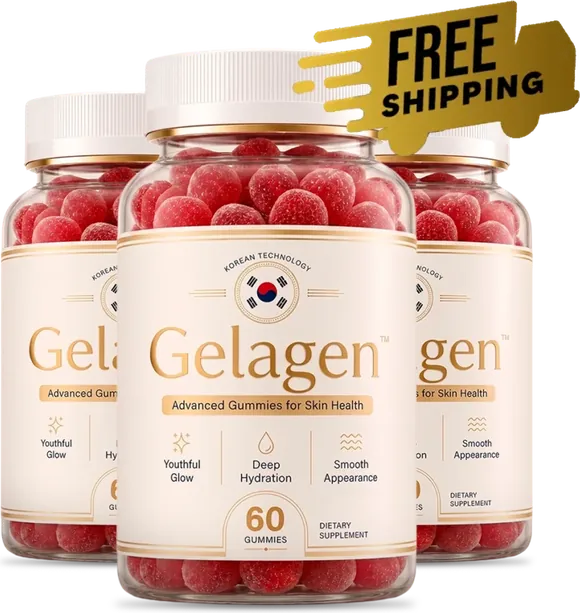
Your First Bottle Of Gelagen
Two gummies with breakfast, a page on this site for every amount printed on the panel, and two months to send the lot back if your skin disagrees.
- Two gummies daily, chewed rather than swallowed
- Thirteen nutrients, every amount printed on the bottle
- Free US delivery and six guides on the 3 and 6 bottle orders
- Sixty days to change your mind, opened bottles included